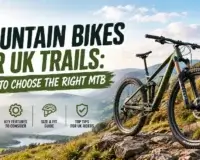


Choosing the right mountain bike for UK trails depends mainly on where you ride, how challenging the terrain is, your experience level and how much you want to spend. For many riders, a hardtail MTB with front suspension is a practical starting point, while riders tackling rough, technical, or consistently demanding trails may benefit from a full-suspension mountain bike.
UK trails can vary considerably. One ride might involve a smooth forest track or gravel path, while another could include mud, roots, rocks, steep climbs and technical descents. That is why you should choose a mountain bike in the UK based on your riding conditions, not just the most expensive or advanced MTB.
This guide explains the key features to consider when choosing mountain bikes for UK trails, including suspension, tyres, gears, brakes, wheel size and frame fit.
What Makes a Mountain Bike Suitable for UK Trails?
A good MTB for UK trails should balance traction, control, comfort, and durability. The right specification depends on the type of trail you ride most often.
For general trail riding, look for:
- A suitable frame size
- Wide, grippy mountain bike tyres
- Reliable disc brakes
- Useful gearing for climbs
- Front suspension for uneven surfaces
- A strong but reasonably lightweight frame
- Comfortable riding geometry
- Components appropriate for your terrain
UK trails can be wet and muddy, so tyre choice and braking performance matter. If your routes include roots, rocks and rough sections, suspension can also make the ride more controlled and comfortable.
CT Bikes’ current Mountain Bikes collection includes a broad range of models and specifications, from hardtail-style bikes to full suspension options, giving riders different choices depending on their intended use.
How to Choose a Mountain Bike for UK Trails
Before buying an MTB, start with the trail, not the bike.
Ask yourself:
Where will I ride most often?
Will you mainly ride:
- Woodland and forest trails?
- Gravel paths?
- Country tracks?
- Hilly trails?
- Muddy routes?
- Rocky terrain?
- Technical singletrack?
- Bike parks and steep descents?
Your answer helps determine whether you need a simple hardtail, a versatile trail bike, or a full-suspension MTB.
Mountain Bikes for Forest and Woodland Trails
For woodland trails, forest tracks and relatively moderate off-road routes, a hardtail mountain bike is often a sensible choice.
Front suspension can smooth out bumps, roots, and uneven ground, while the rigid rear frame keeps the bike simple and efficient.
A hardtail is particularly useful for riders who want an affordable mountain bike for UK trails without adding unnecessary complexity.
Mountain Bikes for Muddy UK Trails
Wet conditions can transform a familiar trail. Mud reduces traction and can make braking and cornering more difficult.
If you regularly ride muddy trails, consider:
- Tyres with suitable tread
- Reliable disc brakes
- Appropriate tyre pressure
- Durable drivetrain components
- Good mud clearance
A bike does not necessarily need the most aggressive specification for muddy trails. Good tyres and sensible riding technique can make a significant difference.
Mountain Bikes for Rocky and Technical Trails
If your regular routes contain rocks, roots, steep sections, and technical obstacles, suspension and control become more important.
A full-suspension mountain bike can provide added comfort and control because it has suspension at both the front and rear. However, it is generally more expensive and mechanically complex than a hardtail.
For experienced riders tackling demanding terrain, the additional capability can make sense.
Hardtail vs Full Suspension for UK Trails
One of the most common questions when choosing an MTB is whether to buy a hardtail or full suspension model.
FeatureHardtail MTBFull Suspension MTB
Front suspension Yes Yes
Rear suspension No Yes
Price Usually lower Usually higher
Maintenance Simpler More complex
Light trail riding Excellent Good
Forest tracks Excellent Excellent
Rough terrain Good Excellent
Technical descents Suitable depending on bike Better suited
Beginner-friendly Very Depends on riding needs
Choose a Hardtail Mountain Bike If:
A hardtail mountain bike can be a great choice if you mainly ride:
- Forest trails
- Gravel routes
- Country tracks
- Moderate hills
- Light-to-medium technical trails
- Mixed recreational routes
Hardtails are also a strong option for beginners because they are relatively simple to maintain and can offer good value.
Choose Full Suspension If:
A full suspension mountain bike is worth considering if you regularly ride:
- Rocky trails
- Root-filled terrain
- Steep descents
- Technical singletrack
- Rough mountain routes
- More demanding off-road terrain
You don’t need full suspension just because you ride off-road. The type and difficulty of your trails should determine whether the extra suspension is worth it.
What Mountain Bike Tyres Are Best for UK Trails?
Mountain bike tyres strongly influence grip, braking, and cornering.
For general UK trail riding, look for tyres that balance rolling efficiency and traction.
For Dry Trails
A moderately treaded tyre can provide a good combination of grip and rolling speed.
For Wet and Muddy Trails
More pronounced tread can help the tyre find traction on softer ground, although the ideal choice depends on the specific trail.
For Rocky Trails
Look for durable tyres with suitable tread and sidewall protection if you regularly ride sharp rocks and rough terrain.
Tyre pressure also matters. Too much pressure can reduce grip on uneven ground, while too little can increase the risk of rim damage or instability.
How Important Are Gears on a Mountain Bike?
Gearing is particularly useful on UK trails because many routes include elevation changes.
A suitable MTB gearing system should help you:
- Climb hills more comfortably
- Maintain control on varied terrain
- Find a comfortable pedalling cadence
- Handle longer trail rides
- Manage changes in gradient
If you regularly ride steep UK hills, having suitable lower gearing can make climbing considerably easier.
However, more gears do not automatically mean a better mountain bike. What matters is whether the gearing range suits your riding.
Mountain Bike Brakes: What Should You Look For?
Reliable braking is essential for trail riding.
Disc brakes are widely used on mountain bikes because they provide strong stopping performance and useful control across different riding conditions.
When choosing an MTB, consider:
- Brake type
- Rotor size
- Brake feel
- Replacement and maintenance requirements
- Your typical terrain
For general recreational trail riding, a reliable braking system can provide the confidence needed for descents and changing trail conditions.
If you regularly ride steep or technical trails, braking performance becomes even more important.
Choosing the Right Mountain Bike Wheel Size
Wheel size is another factor to consider when choosing mountain bikes for UK trails.
Common MTB wheel sizes include:
- 26-inch: Traditional option, still found on some mountain bikes
- 27.5-inch: A versatile option offering a balance of agility and stability
- 29-inch: Larger wheels can roll efficiently over obstacles and provide good stability
The best wheel size depends on the bike design, your height, riding style and the terrain you intend to ride.
Do not choose a mountain bike based on wheel size alone. Frame fit and overall bike design matter more for a comfortable, controlled ride.
Mountain Bike Frame Size: Get the Fit Right
A correctly sized frame can make a major difference to comfort and handling.
An MTB that is too large may feel difficult to control, while one that is too small can feel cramped.
Before buying, check the manufacturer’s sizing recommendations and consider:
- Your height
- Inside-leg measurement
- Reach
- Riding position
- Frame geometry
- Intended riding style
If you are between sizes, the right choice depends on the bike’s geometry and your preferences. When possible, check the manufacturer’s size chart rather than relying on a generic size guide.
What Is the Best Mountain Bike for Beginners in the UK?
For many beginners, a hardtail mountain bike is a sensible starting point for UK trails.
It offers:
- Front suspension
- Good off-road capability
- Simpler maintenance
- Generally lower cost
- Stable handling
- Suitable performance for many beginner trails
CT Bikes already has a separate beginner-focused mountain bike buying guide, so this article focuses specifically on matching an MTB to UK trail conditions rather than repeating general beginner buying advice. (CT Bikes)
If you already know that you will regularly tackle technical and rough terrain, however, a full-suspension MTB may be worth considering.
Mountain Bike Safety for UK Trail Riding
The right bike is only part of a safe trail experience.
Before heading out:
- Wear a properly fitted cycling helmet.
- Check your brakes and tyres.
- Make sure your gears shift correctly.
- Carry basic repair equipment.
- Take water for longer rides.
- Check the trail conditions and weather.
- Ride within your ability.
- Slow down before corners and technical sections.
- Respect other trail users and local trail rules.
Wet roots, loose rocks and mud can significantly change how a trail behaves, so adjust your speed and riding technique accordingly.
How to Maintain Your MTB After UK Trail Rides
UK trail conditions can be tough on bicycles, particularly during wet and muddy rides.
After a muddy ride:
- Remove excess mud carefully.
- Clean the drivetrain.
- Check the chain.
- Inspect the brake pads and rotors.
- Check tyre condition and pressure.
- Look for loose bolts or unusual noises.
- Lubricate the chain when appropriate.
- Store the bike somewhere dry.
Regular maintenance helps your mountain bike stay reliable and can catch problems before they become expensive repairs.
Why Choose Mountain Bikes from CT Bikes?
If you’re looking for mountain bikes in the UK, CT Bikes offers a broad collection covering different budgets, designs and riding requirements.
The current Mountain Bikes category includes models such as the Falcon Maverick 26-inch, several Python Rock variants, Bergamont models, Tiger Momentum, Tiger Hazard and Tiger Ace V3, among others. The collection also includes both front-suspension and full-suspension options. (CT Bikes)
This range lets riders compare frame sizes, wheel sizes, suspension setups, and price points before choosing an MTB suited to their intended riding.
Explore the CT Bikes Mountain Bikes collection and compare the available options for your next UK trail adventure.
Key Takeaways
Choosing the right mountain bike for UK trails comes down to matching the bike to your actual riding conditions.
- Choose a hardtail for many forest, gravel and moderate trails.
- Consider full suspension for rougher and more technical terrain.
- Prioritise the right frame size and a comfortable fit.
- Choose tyres according to the surfaces you ride.
- Make sure the gearing suits local climbs.
- Look for reliable brakes and suitable suspension.
- Consider wheel size alongside frame fit and riding style.
- Maintain your MTB after muddy or wet rides.
There is no single best mountain bike for UK trails for everyone. The right MTB matches your terrain, experience, body size, riding goals, and budget.
Conclusion
The UK’s varied trail network makes mountain bikes an excellent choice for riders who want to explore forests, countryside, hills, gravel tracks and off-road routes.
For many riders, a hardtail MTB provides the right combination of simplicity, control and value. If you regularly tackle rocky, technical, or demanding trails, a full-suspension mountain bike may provide greater comfort and control.
Before buying, think about where you will actually ride. Then compare the bike’s suspension, tyres, brakes, gearing, wheel size and frame fit.
Most importantly, don’t choose an MTB simply because it has the most features. Choose a bike that gives you the right balance of control, comfort, durability and performance for the trails you ride.
FAQs About Mountain Bikes
What is the best mountain bike for UK trails?
The best mountain bike for UK trails depends on the type of terrain you plan to ride. A hardtail mountain bike is suitable for forest trails, gravel paths, bridleways, and moderate off-road routes, while a full-suspension MTB can be better for rough, rocky, and technical terrain.
Is a hardtail mountain bike good for UK trails?
Yes, a hardtail mountain bike is an excellent choice for many UK trails. It works well on woodland paths, gravel tracks, country trails, and moderate off-road terrain. Hardtail MTBs are also generally lighter, simpler to maintain, and more affordable than full-suspension bikes.
Is full suspension better for UK mountain biking?
A full-suspension mountain bike can be better for rough, rocky, and technical UK trails. Front and rear suspension help absorb impacts while improving traction, comfort, and control. However, full suspension is not essential for smoother forest tracks, gravel paths, and less technical trails.
What mountain bike tyres are best for muddy UK trails?
For muddy UK trails, mountain bike tyres with deeper and widely spaced tread can provide better grip and help clear mud from the tyre surface. The ideal tyre depends on trail conditions, with wetter and softer terrain generally requiring more aggressive tread.
What size mountain bike should I buy?
Choose your mountain bike frame size based on your height, inside-leg measurement, and the manufacturer’s sizing chart. A correctly fitted MTB can improve comfort, handling, and control. While wheel size is also important, choosing the right frame size should be a priority.
Where can I buy mountain bikes in the UK?
You can explore the mountain bikes collection at CT Bikes, with options designed for different riding styles, trail conditions, frame sizes, and wheel sizes. Compare the bike’s suspension, tyres, gearing, frame size, and intended terrain to find the right MTB for your needs.